Providers / Play'n GO / Honey Rush
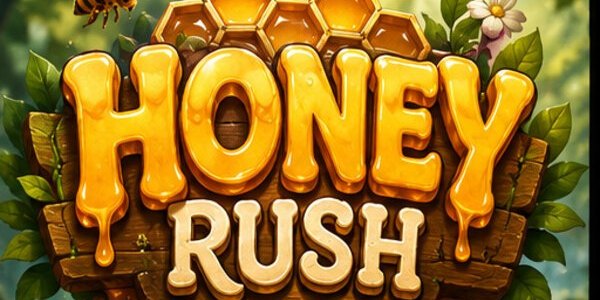
Honey Rush
Honey Rush is a slot from Play'n GO, a studio known for book-of expanding symbols and cascading grids. Check the stats below, then confirm them in the game's own info screen before you play for real money.
Game facts
Provider: Play'n GO
RTP: 96.5%
Volatility: High
Maximum win: 9,000x
Main feature: Cluster
Play responsibly
Operators can run different RTP versions of the same game, so the figure shown in your casino lobby may not match the one above. Always open the in-game info screen and confirm it yourself.
Set a deposit limit before you start and treat any win as a bonus, not an income.
- Provider
- Play'n GO
- Default RTP
- 96.5%
- Volatility
- Very high
- Maximum win
- 9,000x
- Core mechanic
- Cluster
IN SHORT
Honey Rush is a very high-volatility online slot from Play'n GO built on a cluster mechanic. Its standard return to player is 96.5% and the published maximum win is 9,000x.
Operators can deploy reduced return configurations of the same game, so the figure in your casino's information screen is the one that applies to you — not the figure published anywhere else, including here.
- RTP 96.5%
- Max win 9,000x
- Volatility Very high
- Provider Play'n GO
- Mechanic Cluster
- What Honey Rush is
- The hexagonal grid explained
- The Rush Meter and three Colonies
- Sticky wilds and the 27x multiplier
- Symbols and paytable
- RTP configurations
- Maximum volatility — 10 out of 10
- The 9,000x ceiling
- Reading the info screen
- Stake sizing in practice
- Honey Rush versus the 100 version
- Common misconceptions
- Who this suits
- Where this fits in a session
- Reading the paytable honestly
- FAQ
What Honey Rush is
Honey Rush is a 2019 Play'n GO slot built on a hexagonal honeycomb grid rather than reels, and it is the studio's most extreme game on this shelf. Play'n GO rates its volatility 10 out of 10 — the top of their own scale.
Default return is 96.50%, with reduced configurations of 94.50%, 91.50%, 87.50% and 84.50% supplied to operators. The maximum win is 9,000x your stake, which is nearly double the 5,000x that most Play'n GO titles cap at.
It is a genuinely well-designed game and it is punishing. Both of those things are true, and this page tries to be honest about the second.
The hexagonal grid explained
The grid is a honeycomb with seven columns running 4-5-6-7-6-5-4 positions, giving 37 total positions arranged as concentric rings rather than rows and columns.
Wins form when five or more matching symbols connect adjacently anywhere on the grid. On a hex layout each position touches up to six neighbours rather than four, so connections form in patterns that are harder to read at a glance than a square grid — worth a few spins to get used to.
Winning clusters are removed, new symbols cascade in, and if the new arrangement forms another cluster of five or more, it pays and the sequence continues until nothing new forms.
The Rush Meter and three Colonies
This is the game's engine. Every winning symbol destroyed adds a charge to the Rush Meter, and three thresholds trigger progressively bigger features within the same spin sequence:
| Charges | Feature | Effect |
|---|---|---|
| 30 | Drone Colony | Creates at least 7 matching symbols on the grid |
| 60 | Worker Colony | Generates 10 to 15 matching symbols |
| 90 | Queen Colony | Produces 20 to 37 symbols with centre-symbol cloning |
The Queen Colony is the game's big moment — converting up to all 37 positions to matching symbols guarantees an enormous cluster and typically a long cascade chain afterward.
Charges accumulate within a single spin's cascade sequence only. Reaching 55 charges and stalling means the next spin starts at zero. That is the single most important thing to understand here: reaching 90 charges requires one continuous sequence of roughly ninety symbol destructions, which is why the Queen Colony is rare.
Sticky wilds and the 27x multiplier
Sticky wilds are added to the grid by the Rush Meter rather than landing naturally. Each carries a multiplier of 1x, 2x or 3x, substitutes for any symbol, and when it forms part of a winning cluster it moves one position to an adjacent empty space before new symbols drop.
You can hold up to three sticky wilds at once. When multiple wilds participate in the same cluster their multipliers combine multiplicatively, so three 3x wilds produce a maximum of 27x on that cluster.
That 27x cap, applied to a Queen Colony cluster, is the route to the 9,000x maximum. Everything else in the game is building toward that specific combination.
Symbols and paytable
| Symbol group | Role | Notes |
|---|---|---|
| Diamond | Top paying symbol | The one you want in a Colony conversion |
| Gold, silver and bronze coins | Mid pays | Standard cluster payouts |
| Flowers (blue, white, pink, yellow) | Low pays | Large clusters of 35 pay only around 20x |
| Honey jar sticky wild | Wild with 1x-3x multiplier | Added by the Rush Meter; moves after each win |
Note the low-symbol figure: a 35-symbol cluster of flowers returns roughly 20x total bet. That tells you plainly that huge clusters of cheap symbols are not where the money is — the multipliers are.
RTP configurations
The default is 96.50%, with some sources citing 96.54% for particular builds. Documented reduced tiers are 94.50%, 91.50%, 87.50% and 84.50%.
On a game with maximum volatility, the configuration matters more than almost anywhere else. You are already accepting long dry spells to chase a rare Queen Colony; doing that on an 84.50% build means paying a 15.5% house edge for the privilege. That is close to the worst combination available in a licensed casino.
Reading the info screen
- The return figure — the single most important check on this title.
- The Colony thresholds, to confirm the 30/60/90 charge structure in your build.
- The sticky wild multiplier values and the maximum number that can be held at once.
- The cluster minimum and how adjacency works on the hex grid.
- The total bet field, which runs from around $0.20 to $100.
Maximum volatility — 10 out of 10
Play'n GO's own rating is the top of their scale, and player accounts consistently describe long sequences of dead or near-zero spins. That is the expected behaviour, not misfortune.
The reason is structural. The meter resets every spin, so value only arrives when a single sequence chains long enough to reach a Colony. Most spins produce one small cluster and stop, contributing a handful of charges that then vanish. Reaching 90 charges in one sequence is a genuinely uncommon event.
There is also no scatter and no free spins round, so there is no alternative route to the features. Either the sequence chains or the spin was nothing.
The 9,000x ceiling
9,000x is high for Play'n GO, whose usual cap is 5,000x. Reaching it needs a Queen Colony conversion on a high-paying symbol with three 3x sticky wilds participating in the resulting cluster — the 27x multiplier applied to a near-full-grid win.
At a $1 stake that is $9,000. It is also an event requiring several rare things to coincide in the same sequence. Wins above 200x are notable here; the ceiling is a description of the tail rather than a plan.
Stake sizing in practice
- Stakes run from about $0.20 to $100 per spin.
- Budget for at least 300 spins. On a 10-out-of-10 volatility game with no scatter route to the features, anything less is likely to be all base game.
- Divide first, then choose the stake. A $150 budget means $0.50 spins, not $5 spins.
- Do not raise stakes after a drought. Meter progress resets every spin, so nothing is warmed up.
- Decide your walk-away number for a win in advance — this variance profile reclaims large balances quickly.
Honey Rush versus the 100 version
| Honey Rush | Honey Rush 100 | |
|---|---|---|
| Default return | 96.50% | 96.20% |
| Maximum win | 9,000x | 50,000x |
| Volatility | 10/10 | High, with a longer tail |
| Grid | Hexagonal, 37 positions | Hexagonal with Overcharge mode |
The 100 version raises the ceiling more than fivefold at a slightly lower default return — which means considerably more of its money is parked in outcomes almost nobody reaches. If the original's dry spells already feel harsh, the sequel is harsher, not better.
Common misconceptions
The first, and the expensive one, is thinking meter progress carries between spins. It does not. A spin that reached 70 charges was a good spin that ended; the next one starts at zero.
The second is that a big cluster is automatically a big win. A 35-symbol flower cluster pays about 20x total bet. Cluster size without multipliers attached is mostly noise.
The third is treating the 9,000x figure as the reason to play. It requires a Queen Colony and three 3x wilds coinciding. The realistic proposition is a well-made high-variance grid game, not a ceiling chase.
Who this suits
This suits an experienced high-variance player who enjoys watching a meter build within a spin, has verified the 96.50% build, and has a bankroll sized for several hundred spins. The hex grid and the Colony escalation are genuinely satisfying design when the sequences run.
It suits nobody with a small budget, nobody new to slots, and nobody prone to chasing. Maximum volatility with no scatter fallback means short sessions are frequently pure base game, and the temptation to raise stakes after a drought is exactly what this distribution punishes hardest. If you want a Play'n GO cluster game where features fire constantly, Reactoonz is the better fit.
FAQ
How does the Rush Meter work?
Destroyed symbols add charges within a single spin sequence. Thirty charges triggers the Drone Colony, sixty the Worker Colony, and ninety the Queen Colony. The meter resets when the sequence ends.
What is the maximum multiplier?
27x — three sticky wilds each carrying 3x, combining multiplicatively on the same cluster.
Does Honey Rush have free spins?
No. There is no scatter and no free spins round. Everything runs through the Rush Meter in base-game sequences.
What is the maximum win?
9,000x your stake, needing a Queen Colony conversion combined with the 27x wild multiplier.
Is the RTP always 96.50%?
No. Documented configurations run 96.50%, 94.50%, 91.50%, 87.50% and 84.50%. On a maximum-volatility game this check matters more than anywhere else.
Where this fits in a session
Honey Rush earns its place as a deliberate high-variance session on a decided budget — not as the game you play all evening and not as the game you switch to after losing elsewhere.
The realistic shape: several hundred spins at a small stake, most of them producing one small cluster and stopping, with occasional sequences that chain into a Drone or Worker Colony and a rare one that reaches the Queen. If a Queen Colony lands with wilds in play, take the result off the table. This distribution reclaims large balances faster than almost anything else on the site.
If you want the studio's grid design without the punishment, Golden Ticket is medium volatility at a 96.73% return, and Reactoonz fires features constantly. Both give a small bankroll a genuine session.
Reading the paytable honestly
Two numbers from the paytable tell you most of what you need to know about this game.
First, a 35-symbol cluster of low-paying flowers returns around 20x total bet. Thirty-five of the thirty-seven positions filled with matching symbols, for twenty times your stake. That is deliberately modest, and it means huge clusters of cheap symbols are scenery rather than substance.
Second, the wild multiplier caps at 27x from three 3x wilds. So the game's mathematics run through multipliers applied to premium-symbol clusters, not through cluster size. A Queen Colony converting the grid to diamonds with three wilds attached is the entire proposition; a Queen Colony converting to flowers is a pleasant animation.
Knowing that changes how you read a sequence in progress, and it stops a big-looking cluster from feeling like a missed fortune when it pays 20x.
Confirm the return figure in the game information screen, budget for several hundred spins, and remember that the meter resets every spin. This page is information, not a recommendation to play.