Providers / Hacksaw Gaming / Hand of Anubis
Hand of Anubis
Hand of Anubis is a slot from Hacksaw Gaming, a studio known for bonus-buy slots and instant-win scratchies. Check the stats below, then confirm them in the game's own info screen before you play for real money.
Game facts
Provider: Hacksaw Gaming
RTP: 96.29%
Volatility: High
Maximum win: 10,000x
Main feature: Sticky respins
Play responsibly
Operators can run different RTP versions of the same game, so the figure shown in your casino lobby may not match the one above. Always open the in-game info screen and confirm it yourself.
Set a deposit limit before you start and treat any win as a bonus, not an income.
- Provider
- Hacksaw Gaming
- Default RTP
- 96.29%
- Volatility
- High
- Maximum win
- 10,000x
- Core mechanic
- Sticky respins
- What Hand of Anubis is
- A 5x6 cluster grid
- Dual multipliers and the symbol drop
- Two paths, two distributions
- The published numbers
- A player-reported 8,600x on a 10,000x cap
- RTP and multiple builds
- Feature buys
- Stake sizing in practice
- Where it sits in the catalogue
- Common misconceptions
- Who this suits
- Cluster wins on a 5x6 grid
- Pace, and budgeting in spins
- Multiple RTP builds
- Where this fits in a session
- FAQ
What Hand of Anubis is
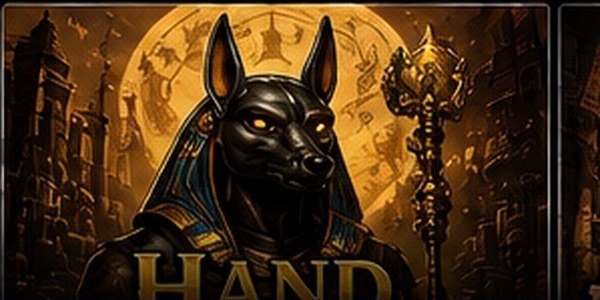
Hand of Anubis is Hacksaw Gaming's Egyptian slot, and it deliberately avoids the gold-and-scarab clichés the theme usually attracts — the art direction is moody and dark rather than golden. Default return is 96.29%, volatility is high, and the maximum win is 10,000x your stake.
Mechanically it is one of the studio's cluster games, running cascading cluster wins across a five-reel, six-row grid with dual multipliers and a dynamic symbol drop.
A 5x6 cluster grid
Thirty positions with wins forming through adjacent symbol groups rather than paylines. That puts it alongside Joker Bombs in Hacksaw's cluster-pays group and distinguishes it from Chaos Crew, which uses 19 fixed lines on a 5x5 grid.
The practical difference is legibility. On a fixed-payline game you can see instantly whether a spin came close. On a cluster grid you have to read adjacency — which symbols touch which — and that takes longer, particularly at Hacksaw's pace where spins resolve in about a second.
Winning clusters are removed and new symbols cascade in, so a single spin can chain through several sequences.
Dual multipliers and the symbol drop
The game's distinguishing feature is its dual multiplier structure combined with a dynamic symbol drop. Rather than a single multiplier applied at the end of a sequence, two multiplier layers interact as the cascade runs.
That is the Hacksaw pattern again: multipliers in this catalogue are almost never plain, single-value additions. On Wanted Dead or a Wild they ride on reel-converting wilds; on RIP City they stack on vertically expanding cats; here they operate in pairs across a cascading cluster grid.
Exactly how the two multiplier layers combine — whether they add, multiply, or apply at different stages — is the single most consequential rule in this game, and Hacksaw ships multiple builds. The rules pages in your version state it. No review, including this one, is a substitute for reading it.
Two paths, two distributions
Hand of Anubis is characterised by having two different paths through its feature set, in the same way Wanted Dead or a Wild has three bonus rounds and RIP City has five.
This is a deliberate house design across the studio: rather than one bonus with one distribution, you get a choice between shapes. The practical guidance is the same everywhere it appears — the cheaper or more accessible path pays more reliably and cannot reach the ceiling; the premium path is where the 10,000x lives.
Decide which you want before you trigger, not on the selection screen after a long wait.
The published numbers
| Statistic | Figure | What it means in a session |
|---|---|---|
| Default return | 96.29% | ~$37 expected cost per $1,000 staked |
| Maximum win | 10,000x | Premium path realistically |
| Grid | 5 reels x 6 rows, cluster pays | Adjacency, not paylines |
| Volatility | High | Standard for this catalogue |
A player-reported 8,600x on a 10,000x cap
One documented data point worth flagging: player-reported wins on this game have exceeded 8,600x, against a published ceiling of 10,000x.
That is unusual and mildly encouraging. On most high-variance slots the gap between the advertised maximum and anything a real player reports is enormous — Tombstone R.I.P. advertises 300,000x and almost nobody sees a four-figure multiple. Here, a reported result sits at 86% of the ceiling.
Read it carefully, though. It means the ceiling is not purely theoretical, not that it is likely. A single reported large win across a game played millions of times tells you the outcome exists; it says nothing about your session. The honest reading: a 10,000x cap on a cluster-cascade game is a reachable-shaped number rather than a marketing figure, which is a point in the game's favour without being a reason to expect anything.
RTP and multiple builds
Published figures include 96.29% and 96.24%. Hacksaw ships multiple RTP builds per title, and which one your casino runs varies.
Demo mode does not confirm it. Only the real-money game info panel shows the active return, stake limits and feature rules at your operator. On a studio where the whole catalogue sits within a fifth of a percentage point, a reduced build is the difference that actually matters.
Feature buys
Buys are offered where jurisdiction permits, with tiers corresponding to the different paths. Each publishes its own return figure — read the one matching your purchase.
Convert to cash first, and know which path the tier buys. Purchasing the accessible path and expecting 10,000x is the standard mistake across this catalogue. Feature purchases are prohibited under UK rules and restricted in several other markets.
Stake sizing in practice
- Budget in spins, not minutes. At roughly a second per spin, a Hacksaw session can stake nearly twice per hour what a conventional slot does at the same bet.
- Around 250 spins is a workable session at this volatility.
- Because cluster adjacency is harder to read at speed, consider slowing yourself deliberately — autoplay with a spin count helps more than it hinders here.
- Do not raise stakes after a drought; cascades carry nothing between spins.
- Take a large result off the table.
Where it sits in the catalogue
| Title | Return | Ceiling | Structure |
|---|---|---|---|
| Wanted Dead or a Wild | 96.38% | 12,500x | 5x5 lines, three bonus rounds |
| Le Bandit | 96.34% | 20,000x (disputed) | Cascades, Golden Squares |
| Chaos Crew | 96.30% | 10,000x | 5x5, 19 paylines |
| Hand of Anubis | 96.29% | 10,000x | 5x6 cluster cascades, dual multipliers |
| RIP City | 96.22% | Check in-game | Expanding wilds, five bonus options |
Hand of Anubis sits mid-table on return and at the modest end on ceiling. Its case is the mechanic — dual multipliers on a cluster grid is a genuinely different engine from the studio's payline games — and the darker art direction, which is a real point of difference in a catalogue defined by neon cartoons.
Common misconceptions
The first is that a reported 8,600x win means the ceiling is achievable in a normal session. It means the outcome exists. Those are different claims.
The second is that dual multipliers automatically means bigger wins. It means a more complex interaction, and the paytable in your build defines it.
The third is reading cluster games as gentler than payline games. The cluster minimum makes wins frequent and small; the volatility rating still says high.
Who this suits
This suits a player who wants a cluster-cascade game with a genuinely dark theme rather than another neon cartoon, and who is comfortable reading adjacency at speed. The dual multiplier structure gives it more depth than its 10,000x ceiling suggests.
It suits less well anyone who wants a readable base game — Chaos Crew's 19 fixed lines are far easier to follow — or anyone chasing a large multiple, since 10,000x is the catalogue's modest end.
FAQ
What grid does it use?
Five reels by six rows with cluster pays — wins form from adjacent symbol groups rather than paylines, and clusters cascade.
What is the maximum win?
10,000x your stake. Player-reported wins have exceeded 8,600x, which is unusually close to a published ceiling.
What are dual multipliers?
Two multiplier layers interacting across the cascade rather than a single value applied at the end. Check your build's rules for exactly how they combine.
Is 96.29% good?
Mid-table for Hacksaw, whose catalogue clusters between roughly 96.2% and 96.4%. Confirm the active build in the real-money info panel.
Is it a cluster game or a payline game?
Cluster pays, alongside Joker Bombs in the studio's cluster group. Chaos Crew and Wanted Dead or a Wild use paylines instead.
Cluster wins on a 5x6 grid
Worth being precise about the structure, because it differs from most of the Hacksaw catalogue and from the Egyptian slots it sits next to in a lobby.
Hand of Anubis uses cascading cluster wins across five reels and six rows — thirty positions — rather than paylines. Wins form when enough matching symbols connect adjacently, those symbols are removed, and new ones drop in from above. If the new arrangement forms another qualifying group, it pays and the chain continues.
That makes it structurally closer to Reactoonz than to Book of Dead, despite the shared theme. If you came looking for an expanding-symbol Book clone, this is a different kind of game entirely.
Player-reported wins exceeding 8,600x have been recorded against a 10,000x ceiling, which tells you the top end is genuinely reachable rather than purely theoretical — unusual, and a point in the game's favour.
Pace, and budgeting in spins
Hacksaw runs fast — roughly a second per spin against about two on older titles. At $0.50 and 96.29%, 800 spins an hour costs around $14.85 in expectation and 1,500 spins around $27.85.
Cascading games make the count harder to hold, because one spin can chain through several cascades and feel like several spins. Count button presses, not events, and set the session in spins rather than minutes.
Multiple RTP builds and the demo trap
96.29% is Hacksaw's default figure and the studio supplies more than one build. Demo mode does not reliably show your casino's active configuration — use it to learn the cascade mechanic, then read the real-money game information panel for the return, limits and feature rules that actually apply to you.
Where this fits in a session
Hand of Anubis is the pick if you want a cascading cluster game with a genuinely reachable top end. Player-reported wins above 8,600x against a 10,000x ceiling is a ratio very few games on this site can claim — most maximums are theoretical in the strictest sense.
Budget 250 to 350 spins. The dual multiplier system means the round's value depends on how long a chain runs, so short sessions will under-represent what the game does.
It is also the most restrained-looking game in Hacksaw's catalogue — a darker Egyptian treatment rather than the neon cartoon style — which makes it the easiest one to sit with for a longer stretch. That is worth naming as a risk as much as a feature.
Read the multiplier rules and the return figure in the real-money info panel, decide which feature path you want before triggering, budget in spins rather than minutes, and set a deposit limit first. This page is information, not a recommendation to play.
Other Hacksaw Gaming slots
 Duel free spins
Wanted Dead or a Wild
Hacksaw Gaming
 Coin collect
Le Bandit
Hacksaw Gaming
 Multiplier wilds
Chaos Crew
Hacksaw Gaming
 Multiplier wilds
RIP City
Hacksaw Gaming